
Reference
Air Purifier Glossary: The Specs Buyers Actually Meet
Every term below is tied to the standard it comes from, so you can read a spec sheet and tell a real claim from a marketing one. Written by the engineering team that builds these units.
HEPA EN 1822 H13 H14 MPPS CADR AHAM AC-1 GB/T 18801 CCM ACH MERV Pre-filter Activated carbon VOC Formaldehyde PM2.5 Laser particle sensor Ionizer UV-C Ozone CARB CE marking SASO / SABER RoHS MOQ OEM / ODM
HEPA
High Efficiency Particulate Air
A mechanical filter that traps particles in a dense pleated fiber pack rather than charging or destroying them. In the US, True HEPA means at least 99.97% capture at 0.3 micron; in Europe the equivalent grades are defined by EN 1822.
EN 1822
European HEPA classification standard
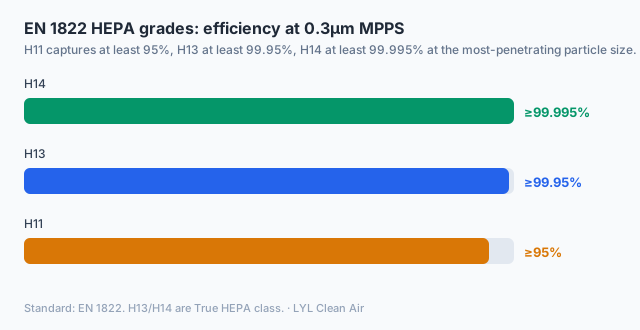
The European standard that classifies filters from E10 to U17 by efficiency at the most-penetrating particle size. H13 captures at least 99.95% and H14 at least 99.995%; both are True HEPA class.
H13
True HEPA grade
The EN 1822 grade capturing at least 99.95% of particles at the most-penetrating size. It is the practical standard for consumer and commercial air purifiers worldwide.
H14
High-grade True HEPA
The EN 1822 grade capturing at least 99.995% - roughly ten times fewer particles pass through than H13. Used in cleanrooms, hospital isolation rooms and laboratories, at the cost of higher airflow resistance.
MPPS
Most Penetrating Particle Size
The particle size a filter is worst at capturing, typically around 0.3 micron. Efficiency is quoted at MPPS because both larger and smaller particles are captured more easily - which is why 0.3 micron appears in HEPA claims.
CADR
Clean Air Delivery Rate
How fast a purifier delivers filtered air into a room, in cubic feet per minute (CFM) or cubic metres per hour. Higher CADR cleans a given room faster. It is an independently tested figure, not a fan-speed rating.
AHAM AC-1
US CADR test standard
The Association of Home Appliance Manufacturers test method behind CADR figures in the US, reported in CFM for smoke, dust and pollen. Its 2/3 rule sizes a unit: CADR in CFM should be at least two-thirds of the room area in square feet.
GB/T 18801
Chinese air purifier standard
The Chinese national standard reporting CADR in cubic metres per hour and adding CCM filter-life grades. 1 CFM equals 1.699 cubic metres per hour, so always confirm which standard a CADR number came from.
CCM
Cumulative Clean Mass
A filter-endurance grade under GB/T 18801: how much pollutant a filter removes before CADR drops to half. Particulate grades run P1 to P4 and formaldehyde grades F1 to F4. CADR is speed; CCM is stamina.
ACH
Air Changes per Hour
How many times per hour a purifier can process a room's full air volume. Roughly 5 ACH is the common target for allergy and smoke rooms; the AHAM 2/3 rule lands close to this figure.
MERV
Minimum Efficiency Reporting Value
The ASHRAE 52.2 scale from 1 to 16 that rates HVAC and general filters by worst-case efficiency across 0.3 to 10 micron. It is a separate, lower scale than HEPA - MERV 13 is strong for HVAC but is not HEPA.
Pre-filter
First filtration stage
A coarse washable mesh or screen that captures hair, lint and large dust so the HEPA layer is not clogged prematurely. It is the only stage that should be rinsed - washing HEPA or carbon destroys them.
Activated carbon
Gas and odor adsorption media
Porous carbon that adsorbs odors, VOCs and formaldehyde, which HEPA cannot capture because they are gases. Performance scales with the mass of carbon, so a thin carbon-coated mesh behaves very differently from a granular bed.
VOC
Volatile Organic Compound
Carbon-based gases released by paints, adhesives, cleaning products and furnishings. Because they are gases, they pass straight through a HEPA layer and require an activated-carbon stage.
Formaldehyde
A specific indoor VOC
A gas emitted by some boards, adhesives and textiles. It needs adsorption media or a decomposition stage; a HEPA layer alone does not remove it, and thin carbon dustings saturate quickly.
PM2.5
Fine particulate matter
Airborne particles 2.5 micron and smaller, small enough to reach deep into the lungs. WHO guidance sets an annual mean of 5 micrograms per cubic metre; HEPA filtration captures this size range effectively.
Laser particle sensor
Auto-mode sensor
The optical sensor behind auto mode and the air-quality display. It measures particles only, so it is blind to odors, VOCs, formaldehyde and CO2 - which is why a purifier can honestly read clean in a smelly room.
Ionizer
Electrostatic particle charging
A stage that charges particles so they clump and settle on surfaces rather than being captured in a filter. Some designs emit ozone as a by-product, which is why mechanical HEPA is the safer default for regulated markets.
UV-C
Germicidal ultraviolet
Short-wavelength UV aimed at microbes. It removes no particles and no VOCs, so a credible design pairs it with HEPA rather than offering it as a substitute; dwell time and lamp placement decide whether it does anything at all.
Ozone
A regulated by-product
A lung irritant that some ionizing and UV designs emit. California's CARB limit is 0.050 ppm tested to UL 867, and purifiers sold there must appear on the CARB registry - which is why we build mechanical HEPA with no intentional ozone.
CARB
California Air Resources Board
The California regulator whose air-cleaner rule caps ozone emission at 0.050 ppm and requires listing on its registry. Amazon enforces it US-wide, so even mechanical HEPA units need to be listed.
CE marking
EU conformity marking
The EU declaration that a product meets the applicable directives - for air purifiers typically the Low Voltage Directive, EMC and RoHS - supported by a technical file and a Declaration of Conformity.
SASO / SABER
Saudi conformity scheme
Saudi Arabia's conformity route: test reports support a Product Certificate of Conformity, then a Shipment Certificate per consignment through the SABER platform. The importer holds the SABER account; the factory supplies the reports.
RoHS
Restriction of Hazardous Substances
The EU restriction on lead, mercury, cadmium and other substances in electrical equipment. It is one of the directives behind a valid CE marking for an air purifier.
MOQ
Minimum Order Quantity
The smallest production run a factory accepts for a model. Ours is 200 units per model as standard, with 50 to 100 unit trial orders on selected models - MOQ, price tiers and certification scope are negotiated together.
OEM / ODM
Manufacturing models
OEM builds an existing design under your brand; ODM develops or adapts the design as well. OEM avoids new tooling cost and reaches market faster, while ODM gives a more distinct product for a higher commitment.
Standards are revised periodically. Confirm the current standard version and the SKU-specific test report with your supplier before printing any claim on packaging.
Buyer FAQ
Frequently Asked Questions
What does CADR mean on an air purifier?
CADR is the Clean Air Delivery Rate: how fast the purifier delivers filtered air into a room, in cubic feet per minute or cubic metres per hour. It is independently tested, and 1 CFM equals 1.699 cubic metres per hour.
What is the difference between HEPA and True HEPA?
True HEPA means at least 99.97% capture at 0.3 micron in US usage, while HEPA-type or HEPA-like labels carry no such guarantee. In Europe the equivalent grades are defined by EN 1822, where H13 captures at least 99.95% and H14 at least 99.995%.
What is CCM on an air purifier spec sheet?
CCM is Cumulative Clean Mass under GB/T 18801: how much pollutant a filter removes before its CADR halves. Particulate grades run P1 to P4 and formaldehyde grades F1 to F4. CADR measures speed, CCM measures filter endurance.
Why is HEPA efficiency always quoted at 0.3 micron?
Because roughly 0.3 micron is the most penetrating particle size, the size a filter is worst at capturing. Both larger and smaller particles are captured more easily, so quoting the worst case is the meaningful figure.