
By the LYL Clean Air Engineering Team · Published Jul 12, 2026 · Updated Aug 6, 2026
The sensor is the most misunderstood component in a modern purifier — and, for brands, one of the most common sources of one-star reviews that engineering could have prevented. Here is what the display actually measures, where it fails, and how honest products are specified.
What a PM2.5 sensor sees — and what it can't
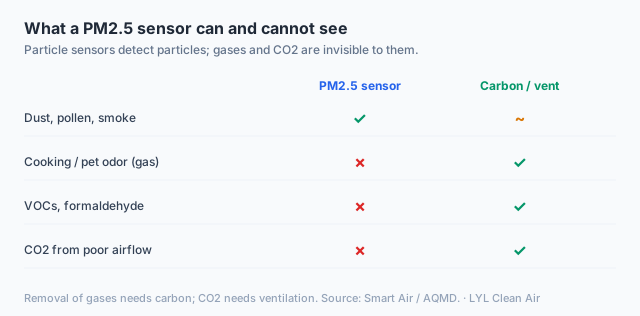
Nearly all purifier displays are driven by a laser-scattering particle sensor: a small fan pulls air past a laser beam, particles scatter light onto a photodetector, and firmware converts the scatter pattern into a µg/m³ estimate. Done well, it tracks real particulate closely. But by physics it is blind to anything that isn't a particle:
| Pollutant | PM2.5 sensor sees it? | What actually handles it |
|---|---|---|
| Dust, pollen, smoke particles | Yes | HEPA layer |
| Cooking smells, pet odor | No (gases) | Activated carbon |
| VOCs, formaldehyde | No (gases) | Carbon mass / impregnated media — see formaldehyde guide |
| CO₂ from poor ventilation | No | Ventilation — no filter removes CO₂ |
So "display says clean, room smells bad" is not a broken unit — it is a particle sensor doing exactly what it does, on a product whose marketing may have implied more.
How accurate are the sensors themselves?
Unevenly. Quality laser modules from reputable suppliers track reference instruments well; cheap modules and older infrared designs respond slowly, miss fine particles, and drift. Independent testing has documented purifier displays underestimating true PM2.5 by more than 200 µg/m³ during pollution episodes — the difference between "hazardous" and "looks fine." This spread is exactly why South Coast AQMD's AQ-SPEC program independently evaluates low-cost air sensors.
Sources: Smart Air — auto-mode test data (Xiaomi/Philips/Levoit); Vacuum Wars — PM2.5 sensors in purifiers; South Coast AQMD AQ-SPEC.
Auto mode: convenient, with a blind spot
Auto mode is a simple loop: sensor reading → fan speed. Its two failure modes follow directly:
- It reacts to what the sensor sees. Odor and VOC events don't raise the fan at all on PM-only units.
- It reacts as fast and as honestly as the sensor reads. Independent testing of popular consumer brands found auto modes leaving substantial pollution uncaptured because the sensor read low or late, keeping the fan slow through the spike.
The balanced recommendation we give brands: position auto mode as a comfort feature for mild conditions, and coach users to run a fixed speed during cooking, smoke events (see the wildfire guide — EPA says highest setting) and allergy season.
What honest sensor engineering looks like (OEM checklist)
- Specify the sensor module, not just "smart sensor." A quality laser-scattering module, with the supplier and response time named in the spec sheet.
- Placement matters: the sensor needs real airflow across it — a sensor buried in a dead corner of the shell reads late by design.
- Auto-mode floor speeds: firmware should never let auto mode idle at zero airflow in occupied-room profiles; a sensible minimum keeps filtration running between readings.
- If you add a TVOC sensor, add the carbon to match. Consumer TVOC modules read only total VOC, drift, and typically need replacement within ~2 years — useful as a trigger, misleading as a promise, and pointless without real carbon mass behind it.
- Display honesty sells long-term: a display that admits "particles only" outperforms one that implies total air quality — in reviews, if not in the first demo.
Speccing a smart line with sensors and app control?
We configure laser PM2.5 modules, optional VOC triggers with matched carbon, and honest auto-mode firmware — with sensor supplier and response data in the spec sheet.
Smart Wi-Fi OEM OptionsFrequently asked questions
Why does my purifier say clean when the room smells?
The display reads a particle sensor; smells are gases, which particle sensors cannot see. Odor removal is the carbon stage's job, and gas detection needs a separate VOC sensor.
Are purifier PM2.5 readings reliable?
Good laser modules track reference monitors well; poor ones have been caught reading 200+ µg/m³ low in independent tests. Sensor quality is a spec-sheet item, not a given.
Should I use auto mode?
For mild everyday air, yes. For cooking, smoke events or allergy season, set a manual speed — auto mode only responds to what its sensor sees, as fast as it sees it.
Related guides
- Smart Wi-Fi air purifier OEM — sensor and app configuration options.
- Wildfire smoke playbook — when to override auto mode entirely.
- Formaldehyde removal — the gas your PM display will never show.
- Noise levels guide — the other spec marketing tends to blur.
Test findings cited from the named public sources; sensor performance varies by module and firmware. Confirm sensor specifications against the SKU documentation.