By the LYL Clean Air Engineering Team · Published Jun 29, 2026 · Updated Aug 20, 2026
If a marketplace asks for CARB evidence, start with the exact brand, model number and EO in CARB's current public list. This guide separates the California regulation from a marketplace's own evidence workflow, so distributors, importers and Amazon FBA sellers do not turn a model-scoped state record into a broader claim.
What CARB Requires, at a Glance
| Requirement | What it means |
|---|---|
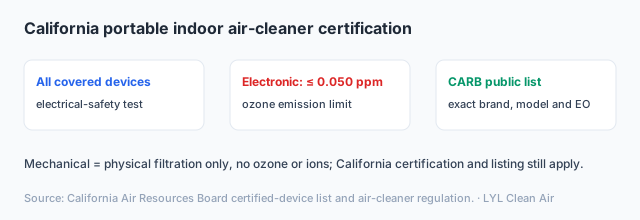
| Ozone limit | Electronic air cleaners must be tested and produce no more than 0.050 ppm. |
| Electrical safety | All air cleaners subject to the regulation must be tested for electrical safety. |
| Listing | The exact model must appear on CARB’s certified air-cleaning devices list — a public registry. |
| Labeling | Unit and packaging must carry the required CARB certification labeling. |
| Scope | Applies to portable indoor air-cleaning devices sold to people or businesses in California; the list classifies devices as Mechanical or Electronic. |
Primary sources: California Air Resources Board, Air Cleaning Devices Regulation and the CARB-certified device list.
How California CARB Status Affects Marketplace Listings
CARB governs sales and shipments to people or businesses in California. Marketplaces may request CARB fields or documents when a listing can be delivered there, but the workflow and affected availability can change. Treat the current Seller Central request as a separate evidence step: match the exact brand, model and EO, and do not describe a California listing as a guarantee that an ASIN will remain active nationwide.
Current CARB Record for LYL-Prefixed Model Numbers
Checked August 20, 2026, CARB's public list shows ten Kleanbe-brand models under EO G-24-126, notified May 31, 2024 and classified Mechanical: Kleanbe24W; LYL-KQXDJ-07, LYL-KQXDJ-08, LYL-KQXDJ-09, LYL-KQXDJ-10, LYL-KQXDJ-11, LYL-KQXDJ-12 and LYL-KQXDJ-13; LYL-Y-ZW-15; and Q-LYL-001.
Evidence boundary: the CARB list identifies the Kleanbe brand, model numbers, technology class, notification date and EO. It does not identify the manufacturer, prove coverage for the LYL Clean Air catalog, or rate pollutant-removal effectiveness. Buyers must match the quoted brand, exact model and configuration to the current list and current documents.
Does a Mechanical HEPA Purifier Really Need It?
Yes, when it is a covered portable indoor air cleaner sold to people or businesses in California. CARB defines Mechanical devices as using physical filtration only and not generating ozone or ions. That classification does not remove the certification and listing requirement or predict the test result of an unlisted configuration.
How to Fix a Suspended Listing
- Identify the exact public record. Match the quoted brand, model number and EO — not a similar SKU — on CARB's current list.
- Get model-linked evidence from the supplier. Request current certification, electrical-safety and, where applicable, ozone-test documents tied to that exact model and configuration.
- Use the current marketplace flow. Respond through the listing's live compliance request and match the requested fields exactly; marketplace steps can change.
- If the model isn’t certified, you cannot “document” your way out. An uncertified model has to be re-sourced or certified — which is why CARB status should be confirmed before the first PO, not after a suspension.
CARB vs the Other US Certifications
Buyers often confuse the US document set. Each covers a different risk and none replaces the others:
- CARB — California air-cleaner certification and public listing; electronic devices are also tested against the ozone limit.
- FCC — electromagnetic interference for electronic products. Required for anything with electronics, including WiFi models.
- ETL / UL — broader electrical-safety certification recognized across North America; often requested by retailers and big-box channels.
For California availability, verify CARB status for the exact quoted brand and model. Separately determine the FCC and electrical-safety evidence required by the product configuration and sales channel.
Verifying CARB Status Before an Order
Make CARB status a pre-order checkpoint. Ask the supplier to confirm in writing: (1) the quoted brand and exact model as it appears on the current CARB list, (2) the matching EO and current model-linked documents, and (3) the label and configuration included in the quote. Keep CARB, FCC and retailer-requested electrical-safety evidence as separate checks.
LYL Clean Air can help buyers compare a quoted configuration with the current public record and assemble available model-specific files. That review is not a catalog-wide certification claim: a model number prefix, similar housing or shared factory platform does not transfer a CARB listing to another brand, SKU or configuration.
Planning a US air purifier launch?
Send the quoted brand, model, functions and sales channel so we can check the current public record and available model-specific files.
Request the Compliance PackRelated Sourcing Guides
- Air purifier certifications & compliance support — the full CE / FCC / RoHS / CARB / ETL / ISO9001 overview.
- Air purifier certification guide — how the global document set fits together.
- Selling air purifiers in Saudi Arabia (SASO/SABER) — the Middle East market-entry path.
- AHAM vs GB/T 18801 CADR — how to read a CADR test report.
- EU CE compliance — the European market gate (CE/LVD/EMC/RoHS).
- Compliance by market — US / EU / Gulf / UK hub.
- Pet & smoke air purifier solution — carbon configuration for odor and VOC positioning.
- Air purifier models — browse the OEM/ODM range and request model-specific compliance files.
This guide is general sourcing information, not legal advice. Certification rules and marketplace policies change — verify current requirements with CARB and your marketplace before importing or listing.