
Data Reference
Air Purifier Statistics 2026: The Numbers That Actually Decide a Spec
20 sourced figures covering market size, indoor air quality, measured filtration performance, and the exact thresholds written into EN 1822, AHAM AC-1, GB/T 18801 and CARB. Every number links to its source. Free to cite with attribution.
Published 21 Jul 2026 · Updated Aug 6, 2026 · LYL Clean Air Engineering Team
Market size and structure
| Figure | What it means | Source |
|---|---|---|
| USD 19.47 bn | Estimated value of the global air purifier market in 2026. | Coherent Market Insights |
| USD 34.24 bn | Projected market value by 2033, a CAGR of 8.4% from 2026. | Coherent Market Insights |
| 41.2% | Share of the 2026 market held by the HEPA filter segment - the largest technology segment. | Coherent Market Insights |
| 39.2% | Asia Pacific share of the 2026 market, the largest region; Europe holds 22.9% and is the fastest growing. | Coherent Market Insights |
| 62.15% | Share of the smart air purifier market held by stand-alone units rather than built-in systems. | Mordor Intelligence |
Why the demand exists: indoor air
| Figure | What it means | Source |
|---|---|---|
| ~90% | Share of their time Americans spend indoors, on average. | US EPA |
| 2 to 5x | How much higher indoor concentrations of some pollutants often are than typical outdoor concentrations. | US EPA |
| 99% | Share of the world's population living in places where WHO air quality guideline levels were not met, in 2019. | World Health Organization |
| 4.2 million | Premature deaths worldwide per year attributed to ambient (outdoor) air pollution in 2019; 6.7 million when household air pollution is included. | World Health Organization |
| more than 90% | Share of the global population in 2019 living where PM2.5 exceeded even the older, looser 2005 WHO guideline of 10 ug/m3. | WHO global air quality guidelines Q&A |
What filtration actually delivers
| Figure | What it means | Source |
|---|---|---|
| 99.97% | EPA: a HEPA filter "can theoretically remove at least 99.97% of dust, pollen, mold, bacteria, and other airborne particles with a size of 0.3 microns". That size is quoted because it is the hardest to catch. | US EPA - What is a HEPA filter? |
| 99.95% / 99.995% | Minimum efficiency at the most-penetrating particle size for EN 1822 grades H13 and H14 respectively. | EN 1822 grades explained |
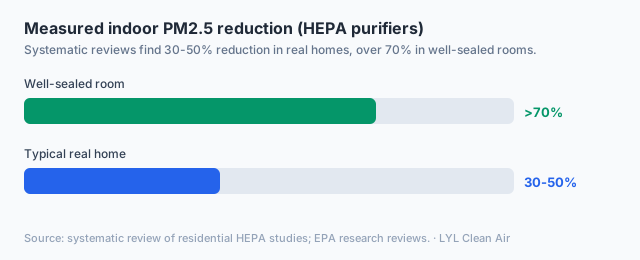
| 30 to 50% | Typical measured reduction in indoor PM2.5 from HEPA purifiers in real homes; over 70% in well-sealed rooms. | Evidence review on our blog |
The numbers on a spec sheet
| Figure | What it means | Source |
|---|---|---|
| 1 CFM = 1.699 m3/h | Conversion between the AHAM (US) and GB/T 18801 (China) CADR units - always confirm which standard a CADR figure came from. | AHAM vs GB/T 18801 |
| 2/3 rule | AHAM sizing rule: CADR in CFM should be at least two-thirds of room area in square feet, giving roughly 5 air changes per hour. | CADR calculator |
| P1-P4 / F1-F4 | CCM filter-endurance grades under GB/T 18801 for particulate and formaldehyde - CADR is speed, CCM is stamina. | CADR vs CCM |
| 1 to 16 | The ASHRAE 52.2 MERV scale for HVAC and general filters - a separate, lower scale than HEPA. | MERV vs HEPA |
Compliance thresholds
| Figure | What it means | Source |
|---|---|---|
| 0.050 ppm | California CARB ozone emission limit for indoor air cleaners, tested to UL 867; units must appear on the CARB registry. | CARB certification guide |
| 3 directives | The EU CE marking for an air purifier typically rests on the Low Voltage Directive, EMC and RoHS, plus a technical file and Declaration of Conformity. | EU CE compliance |
| 2 certificates | Saudi market entry needs a Product Certificate of Conformity plus a Shipment Certificate per consignment through SABER. | SASO and SABER guide |
Citing these figures
Each row links to its primary source. Where a row links to one of our own guides, that guide carries the underlying citation. If you use this page, a link back to lylcleanair.com/air-purifier-statistics.html is appreciated.
Market forecasts are third-party estimates and are revised periodically; standards are revised too. Confirm the current standard version and the SKU-specific test report with your supplier before printing any claim on packaging. We do not publish model-level CADR or wattage here - those belong in the test report for the specific SKU.
Buyer FAQ
Frequently Asked Questions
How big is the air purifier market in 2026?
The global air purifier market is estimated at USD 19.47 billion in 2026 and is projected to reach USD 34.24 billion by 2033, a CAGR of 8.4%, according to Coherent Market Insights. The HEPA segment holds about 41.2% of the 2026 market.
How much do air purifiers actually reduce indoor PM2.5?
Measured studies in real homes typically show HEPA purifiers cutting indoor PM2.5 by about 30 to 50%, rising above 70% in well-sealed rooms where the unit is correctly sized and run continuously.
Why is indoor air quality a concern?
The US EPA reports that Americans spend approximately 90 percent of their time indoors, and that concentrations of some pollutants are often 2 to 5 times higher indoors than typical outdoor concentrations.
What ozone limit applies to air purifiers sold in California?
California's CARB rule caps ozone emission from indoor air cleaners at 0.050 ppm, tested to UL 867, and requires the unit to be listed on the CARB registry. Amazon enforces this US-wide.