
By the LYL Clean Air Engineering Team · Published Jul 4, 2026 · Updated Aug 10, 2026
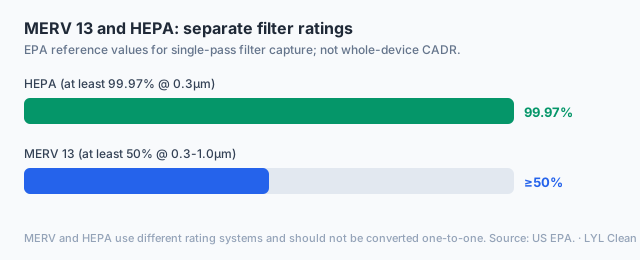
Buyers often ask a factory for "a MERV 13 air purifier" or "a HEPA HVAC filter" — mixing two rating systems built for different products. Getting this right protects both your spec and your marketing claims.
MERV vs HEPA, Side by Side
| MERV | HEPA | |
|---|---|---|
| Standard | ASHRAE 52.2 (since 1987) | EN 1822 (EU) / US HEPA spec |
| Scale | MERV 1–16 | H11–H14 (EN 1822); above MERV 16 |
| Efficiency reference | MERV 13 ≥50% at 0.3–1.0µm | HEPA ≥99.97% at 0.3µm |
| Typical use | HVAC, in-duct, building systems | Standalone air purifiers, cleanrooms, medical |
| Buyer expectation | HVAC contractors, facilities | Retail / Amazon shoppers expect the HEPA label |
Sources: US EPA — MERV ratings; ANSI/ASHRAE 52.2 testing.
How Close Is MERV 13 to HEPA?
No. The current US EPA MERV table lists MERV 13 at ≥50% for 0.3–1.0 µm, ≥85% for 1.0–3.0 µm and ≥90% for 3.0–10 µm. HEPA is a separate classification with a reference value of at least 99.97% at 0.3 µm. In a real unit, airflow, bypass leakage and filter loading determine how those filter ratings translate into delivered clean air.
What This Means for Your Product
For a standalone air purifier, specify the filter class supported by the exact filter report and verify the assembled unit's CADR. MERV normally applies to general ventilation filters. Under EN 1822 terminology, E10–E12 are EPA classes and H13–H14 are HEPA classes; do not market an E11 filter as H11 HEPA. Match every carton and listing claim to the document set for that SKU and target market.
Sourcing a HEPA air purifier line?
Tell us your target market and we will recommend the HEPA grade and configuration, with the test reports to back the claim.
Request Model OptionsComparing in-duct filtration against a room unit? See whole-house vs portable air purifier.
Related Guides
- Corsi-Rosenthal box vs commercial purifier — MERV-13 physics in action.
- HEPA H13 vs H14 — choosing within the HEPA grades.
- Ionizer vs HEPA — and the ozone question.
- Verifying HEPA quality — documents to request.
- Air purifier models — browse the OEM/ODM range.
General sourcing information. Confirm filter grade and test method against the SKU test report.