By the LYL Clean Air Engineering Team · Published Jun 3, 2026 · Updated
When sourcing or developing an OEM air purifier, one of the most frequently misunderstood specifications is HEPA filter grade. Buyers often ask: Should I use H13 or H14? What is the real difference? Does it affect cost significantly? This guide answers those questions with clear, practical information for importers, brand owners and distributors.
Comparing other filter standards? See MERV vs HEPA and UV-C vs HEPA. Deutsche Version: H13 oder H14 Filter.
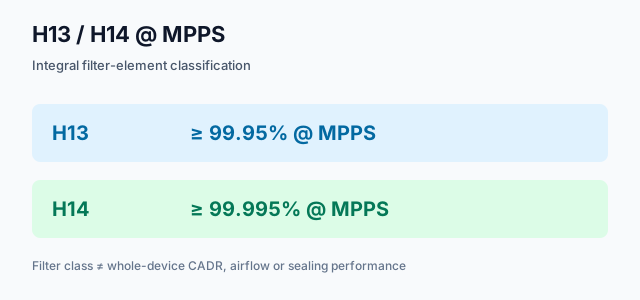
Under DIN EN 1822-1, H13 and H14 are filter-element classes evaluated at the most penetrating particle size (MPPS). H14 has the stricter integral efficiency criterion, but filter class alone does not establish whole-device CADR, airflow, noise or sealing performance. OEM buyers should verify the exact filter report and the final installed configuration.
What Does HEPA Grade Actually Mean?
DIN EN 1822-1 describes the classification, performance testing and marking of EPA, HEPA and ULPA filters. Classification uses particle-counting methods and integral and local efficiency values. It does not replace testing of the complete air purifier.
| Check | H13 | H14 |
|---|---|---|
| Integral efficiency at MPPS | at least 99.95% | at least 99.995% |
| Maximum integral penetration | 0.05% | 0.005% |
| Also verify for an OEM decision | Pressure drop, airflow, sealing, bypass leakage, CADR and noise in the final device configuration | |
Filter Class Is Not Whole-Device Performance
The most penetrating particle size (MPPS) depends on the filter medium and test conditions; it should not be replaced by a fixed particle-size claim. Ask the supplier for the report covering the exact filter element offered for the project.
An H13 or H14 designation is a filter-element class. OEM buyers still need evidence for pressure drop, airflow, installed sealing and bypass leakage, whole-device CADR, noise and power consumption. These values should refer to the final fan, filter and housing configuration.
Evidence to Request Before Selecting H13 or H14
- The exact filter and device model numbers.
- The test report for the filter element actually offered.
- The reported MPPS, integral efficiency and test method.
- Installed sealing or bypass-leakage evidence.
- CADR, airflow, noise and power data for the final device.
- Documents mapped to the target market, voltage, plug and product variant.
Common Mistakes to Avoid When Specifying HEPA Grade
- Using a filter-class claim without the exact report — Request the report for the specific filter model, including the named test method and MPPS result. Do not treat an unspecified “equivalent” certificate or a generic supplier document as proof for the filter installed in the final device.
- Mixing up "HEPA-type" and a tested filter class — "HEPA-type" does not establish an H13 or H14 classification under DIN EN 1822-1. Ask for the report covering the exact filter model instead of relying on a marketing label.
- Not planning filter replacement SKUs — Whether you choose H13 or H14, define the replacement filter part number, model-specific replacement guidance and packaging before bulk production begins.
Filter Programme Planning for OEM Brands
Building a filter replacement programme alongside your main purifier SKU is one of the most effective ways to create repeat purchase revenue. Key decisions to make during OEM development:
- Filter replacement guidance for the exact filter/device model and intended operating conditions
- Whether the replacement filter will be sold under your brand or a generic SKU
- Packaging: retail-ready individual box vs multipack
- Whether to include a filter life indicator on the device
LYL Clean Air supports full filter programme development as part of OEM/ODM projects, including custom filter packaging and co-branding options. Contact us to discuss your project requirements.