
By the LYL Clean Air Engineering Team · Published Jun 29, 2026 · Updated Aug 6, 2026
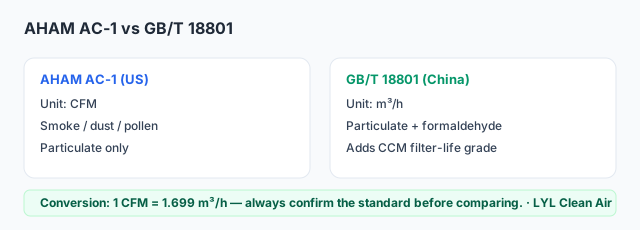
CADR — Clean Air Delivery Rate — is the headline number on almost every air purifier spec sheet. But “CADR 400” from a Chinese factory and “CADR 240” from a US-targeted datasheet can describe the same machine. The difference is the standard and the unit behind the number. Reading the report correctly is what separates a confident sourcing decision from a returns problem.
Side-by-Side: AHAM AC-1 vs GB/T 18801
| ANSI/AHAM AC-1 (US) | GB/T 18801 (China) | |
|---|---|---|
| CADR unit | CFM (cubic feet/min) | m³/h (cubic metres/hour) |
| Pollutants | Smoke, dust, pollen (particulate only) | Particulate + formaldehyde (gaseous) |
| Filter life | Not measured | CCM grade (P1–P4 / F1–F4) |
| Test chamber | ~28.3 m³ (1008 ft³) | 30 m³ |
| Certification | AHAM Verifide (third-party, voluntary) | National standard; tested by CMA/CNAS labs |
| Primary markets | US, Canada, AHAM-driven retail | China, much of Asia & Middle East |
Sources: AHAM Verifide — air filtration standards; GB/T 18801-2022, Air cleaner; Smart Air — CADR test standards.
AHAM AC-1, in Plain Terms
ANSI/AHAM AC-1 became a US national standard in 1988 and was last revised in 2020. It uses a sealed-chamber decay method and reports three CADR numbers by particle size:
- Smoke CADR — particles 0.09–1.0 microns (the smallest and hardest to capture)
- Dust CADR — particles 0.5–3.0 microns
- Pollen CADR — particles 5.0–11.0 microns (the largest)
If a model carries the AHAM Verifide seal, those three numbers and a recommended room size have been independently verified — which is what US retailers and Amazon buyers expect to see.
GB/T 18801, and Why CCM Matters
GB/T 18801 (current edition GB/T 18801-2022; the widely-cited GB/T 18801-2015 took effect in March 2016) reports CADR in m³/h and goes further than AHAM in two ways that matter to buyers:
- Formaldehyde CADR — a separate gaseous-pollutant number, important for new-home and Asian markets where formaldehyde claims sell.
- CCM (Cumulative Clean Mass) — the filter-life grade. It is the mass of pollutant captured before CADR falls to half of the new-filter value. Particulate CCM is graded P1–P4 (P4 is the highest, at least 12,000 mg) and formaldehyde CCM is graded F1–F4. A high CADR with a low CCM means strong airflow but a filter that fades fast — a hidden cost-of-ownership trap.
GB/T also defines an applicable area, derived as roughly CADR × 0.07 to 0.12 for a 2.4 m ceiling (the higher factor assumes a better-sealed room).
The Conversion Every Buyer Needs
Because the units differ, never compare a CFM number to an m³/h number directly:
- 1 CFM = 1.699 m³/h (to go from m³/h to CFM, divide by 1.699).
- Example: a GB/T particulate CADR of 400 m³/h is about 235 CFM — not 400 CFM.
So a factory quoting “CADR 400” (m³/h) and another quoting “CADR 235” (CFM) may be selling equally capable machines. Always normalise to one unit and one standard first.
What to Ask For, by Market
- US / Canada / AHAM-driven retail: request AHAM AC-1 CADR in CFM (smoke/dust/pollen), ideally AHAM Verifide.
- China / Asia / Middle East: request GB/T 18801 in m³/h with the CCM grade and, where relevant, the formaldehyde CADR.
- Every market: ask whether the number is the tested value for the exact SKU, and get the test report — not a marketing figure.
Need CADR data in the right format for your market?
Tell us your target country and we will provide model test data — AHAM-style CFM or GB/T m³/h with CCM — for the exact SKU.
Request Model Test DataRelated Sourcing Guides
- CADR and room size — how to match a CADR number to the room it is sold for.
- HEPA H13 vs H14 — filter grade and its effect on positioning.
- Replacement filter cost — why CCM and filter life drive total cost of ownership.
- Air purifier models — browse the OEM/ODM range and request test data.
This guide is general sourcing information. Standard editions and test methods are updated periodically — confirm the current standard version and the SKU-specific test report with your supplier.