By the LYL Clean Air Engineering Team · Published Jun 30, 2026 · Updated Aug 6, 2026
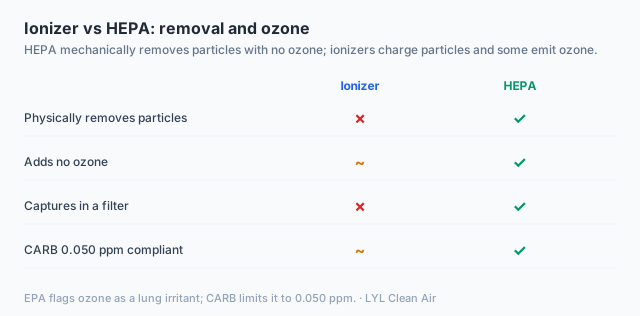
“Ionizer” and “HEPA” get listed side by side on spec sheets as if they were interchangeable. They are not. One physically removes pollution; the other rearranges it — and can create a new problem. For a brand putting its name on the box, the difference is a compliance and trust decision.
HEPA vs Ionizer, Side by Side
| HEPA | Ionizer | |
|---|---|---|
| How it works | Mechanically traps particles in a dense filter | Charges particles so they clump and settle |
| Particles removed? | Yes — pulled out of the air (99.95–99.97% @0.3µm) | No — settled onto surfaces, can re-disperse |
| Ozone byproduct | None | Often emits some ozone |
| Best for | Allergens, dust, smoke, pollen, pet dander | Supplemental fine-particle knock-down only |
| Consumable | Replacement filter (a reorder revenue stream) | No filter (but no real removal either) |
Sources: US EPA — ionizers & ozone-generating cleaners; Airthereal — ozone vs ionizer vs HEPA.
The Ozone Problem
This is the deciding factor. A mechanical HEPA filter has no electrical discharge and produces no ozone. Many ionizers, by design, generate small amounts of ozone as they charge the air. The US EPA describes ozone as a lung irritant that can cause coughing, chest tightness and worsened asthma, and California’s CARB caps indoor air-cleaning devices at 0.050 ppm ozone — the same gate that pulls non-compliant units from Amazon. So an ionizer-forward design is not just a performance question; it is a market-access risk in the US and EU.
When an Ionizer Adds Value
Ionizers are not useless — they can give a small extra knock-down of ultrafine particles. The professional approach is to keep mechanical HEPA + activated carbon as the core and offer any ionizer as a switchable, low-ozone or ozone-free option, so the unit still passes CARB and EU requirements and the buyer can market it cleanly. Selling “ionizer-free” or “ozone-free” is increasingly a trust advantage, not a missing feature.
What This Means for Your Product Line
LYL Clean Air’s core line is mechanical HEPA + activated carbon with no intentional ozone, which keeps it clean against the ozone scrutiny that ionizer and PCO designs attract, and CARB-ready for the US. If your channel wants an ionizer feature, we can configure it as an optional mode rather than the primary mechanism — you get the marketing line without the compliance headache.
Want a clean, ozone-free HEPA line?
Tell us your target market and we will recommend mechanical HEPA + carbon models that pass CARB and EU requirements.
Request Model OptionsRelated Guides
- UV-C vs HEPA — the other “active” technology, compared honestly.
- CARB certification & the ozone limit — why ozone matters for US listings.
- Pet & smoke solution — HEPA + carbon for odor and dander.
- HEPA H13 vs H14 — choosing the filter grade.
- Compliance by market — US / EU / Gulf certification hub.
General sourcing information, not legal advice. Verify ozone limits and certification requirements for your target market before listing.