
By the LYL Clean Air Engineering Team · Published Jun 30, 2026 · Updated Aug 6, 2026
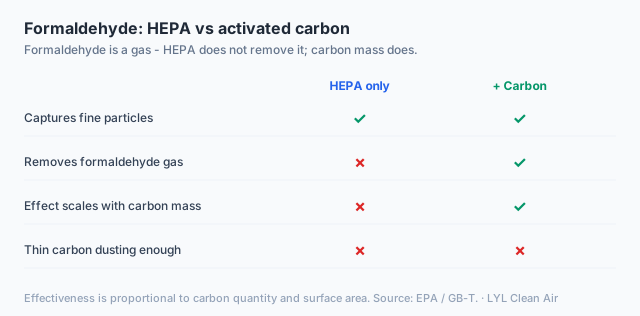
Formaldehyde sells — in new-build, post-renovation, and new-furniture markets across Asia, the Gulf and beyond. It is also the claim most likely to get a brand into trouble, because the most common air-purifier technology, HEPA, does nothing for it. Here is the honest engineering, and how to turn it into a defensible product.
Particles vs Gases: What Removes What
| Pollutant | Type | What removes it |
|---|---|---|
| Dust, pollen, smoke, dander | Particles | HEPA (mechanical) |
| Formaldehyde, VOCs | Gases | Activated carbon / specialized media (enough of it) |
| Odors | Gases | Activated carbon |
Sources: Smart Air — carbon, formaldehyde & VOCs; AllerAir — removing formaldehyde.
Why HEPA Can’t, and Carbon Can
A HEPA filter is a mechanical sieve for particles. Formaldehyde is a gas molecule, orders of magnitude smaller — it passes straight through. Activated carbon works differently: it captures gas molecules by physical adsorption, trapping them inside an enormous internal pore network. That is why every serious formaldehyde purifier is a HEPA + activated carbon design — HEPA for the particles, carbon for the gas.
The Catch: Carbon Mass Decides Everything
Here is the detail cheap units hide. Carbon performance is proportional to how much carbon there is. A filter with a light spray of carbon on a fabric mesh will knock down a smell for a few days, then saturate. Meaningful, lasting formaldehyde removal needs carbon measured in kilograms, or impregnated/modified carbon tuned for formaldehyde specifically. So the question to ask a factory is never “does it have carbon?” — it is “how many grams, and what type?”
How to Spec a Credible Formaldehyde Claim
- Carbon weight in grams/kg, and whether it is granular or impregnated/catalytic carbon
- Formaldehyde CADR (GB/T 18801, in m³/h) — how fast it removes formaldehyde
- Formaldehyde CCM grade F1–F4 — how long the media lasts before fading
- Replacement interval — carbon saturates, so plan the reorder filter SKU
- Claim wording backed by the model’s test report — never copy a number you can’t prove
Get those five and your formaldehyde claim is defensible to buyers, marketplaces and regulators alike.
Building a formaldehyde / new-home line?
Tell us your target market and we will recommend a HEPA + carbon configuration with the carbon weight and formaldehyde test data to back the claim.
Request a Formaldehyde SpecRelated Guides
- Granular carbon vs carbon cloth — choosing the carbon format for VOCs.
- AHAM vs GB/T 18801 — where formaldehyde CADR and CCM come from.
- Replacement filter cost — planning the carbon reorder SKU.
- Air purifier models — browse the OEM/ODM range.
General sourcing information, not a performance guarantee. Formaldehyde removal depends on carbon type, mass, airflow and room conditions — confirm with the SKU-specific test report.