
By the LYL Clean Air Engineering Team · Published Jun 30, 2026 · Updated Aug 6, 2026
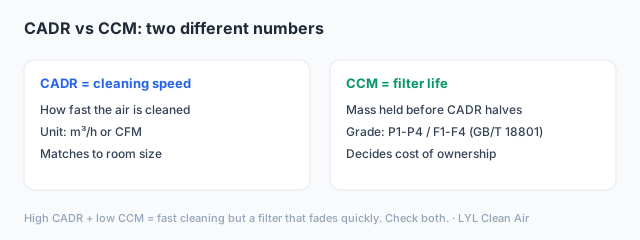
Spec sheets shout CADR and whisper CCM — if they mention CCM at all. But for a brand planning a product line, CCM is where the customer’s long-term cost (and your replacement-filter revenue) actually lives. Understanding the pair is what separates a one-time sale from a repeat-purchase program.
CADR vs CCM, Side by Side
| CADR | CCM | |
|---|---|---|
| Measures | Cleaning speed | Filter life / endurance |
| Unit / grade | m³/h (or CFM) | P1–P4 (particles), F1–F4 (formaldehyde) |
| Higher means | Cleans a room faster | Filter lasts longer before fading |
| Buyer impact | Performance / room-size match | Cost of ownership / reorder cadence |
Sources: IQAir — CADR vs CCM long-term performance; GB/T 18801-2022, Air cleaner.
Sizing tip: CADR only helps if it matches the room. Use our air purifier CADR calculator to turn a room size into the CADR (CFM and m³/h) you need.
What CCM Actually Is
CCM — Cumulative Clean Mass — is the total mass of pollutant a filter captures before its CADR falls to half of the new-filter value. GB/T 18801 grades it: particulate CCM runs P1 to P4 (P4 is the highest, at least 12,000 mg), and formaldehyde CCM runs F1 to F4. In plain terms, CCM is a durability rating: a P4 filter holds far more dust before it needs replacing than a P1.
The Trap: High CADR, Low CCM
Because CADR and CCM are measured separately, a unit can post an impressive CADR and a weak CCM. That looks great on the box and disappoints six months later: the filter saturates fast, CADR quietly drops, and the end customer either replaces filters constantly or leaves a one-star review saying “it stopped working.” A cheap, thin filter is the usual cause — strong fan, short-lived media. For a brand, this is the returns-and-reviews trap.
Turn CCM Into a Selling Point
The flip side: a strong CCM is a story your competitors can’t fake. Pairing a solid CADR with a P4/F4-grade filter lets you advertise a longer replacement interval, lower yearly running cost, and a predictable reorder schedule — which is also your repeat-revenue program. When you spec a model, ask for both the CADR and the CCM grade, and plan the replacement-filter SKU from day one.
Want models with strong CADR and CCM?
Tell us your target market and we will recommend models with the CADR and CCM grade data, plus a replacement-filter plan.
Request Model DataRelated Guides
- CADR and room size — matching CADR to the room.
- AHAM vs GB/T 18801 — where CADR and CCM are defined.
- Replacement filter cost — turning CCM into a reorder program.
- Air purifier models — browse the OEM/ODM range.
General sourcing information. CADR and CCM figures are model-specific — confirm the values on the SKU test report.