By the LYL Clean Air Engineering Team · Published Jul 9, 2026 · Updated Aug 6, 2026
"Can I just wash it?" threads appear in air-purifier communities weekly, usually next to a photo of a grey filter. The instinct is reasonable — replacement filters cost money — but the physics is unforgiving, and a brand that lets buyers believe otherwise trades short-term goodwill for long-term complaints about "a purifier that stopped working." Here is what actually happens inside the media.
Why washing destroys a standard HEPA
HEPA media captures particles mechanically: a maze of ultra-fine fibers grabs particles by interception, impaction and diffusion. That maze is the product. Soak it and the fibers clump, swell and break; creases open invisible channels that air (and particles) sail through. The filter dries out looking pristine — the damage is to efficiency, which you cannot see. Reviewers who test filters agree: if the packaging does not say washable, washing ends its useful life.
Why vacuuming barely helps
Gentle vacuuming lifts loose hair and surface dust, and for a filter coated in pet hair it is worth a careful pass. But most of a filter's captured load sits deep inside the fiber mat where suction cannot reach, so the pressure-drop and efficiency gains are small — and pressing the nozzle into the media risks tears that are worse than the dust. Treat vacuuming as cosmetic maintenance, not life extension.
Sources: Smart Air — cleaning and washing HEPA filters; Molekule — HEPA cleaning guidance.
What each layer can take
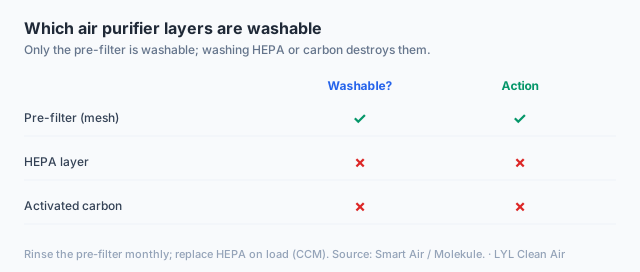
| Layer | Washable? | Right maintenance |
|---|---|---|
| Pre-filter (mesh) | Yes — designed for it | Rinse or vacuum monthly; this is what truly extends HEPA life |
| HEPA layer | No (unless marketed washable) | Replace on schedule/indicator; gentle surface vacuum only for visible hair |
| Activated carbon | No — water saturates it | Replace with the filter; carbon exhausts by adsorption, not clogging |
How long a HEPA really lasts
Run time and pollutant load decide it, not the calendar. Normal residential use typically means replacement every 6–12 months; wildfire seasons, heavy dust, cooking smoke or several pets shorten it. This is exactly what China's GB/T 18801 standard quantifies as CCM (Cumulative Clean Mass) — the milligrams of pollutant a filter absorbs before its CADR halves, graded P1–P4. Two filters of identical size can differ several-fold in real life span; the grade, not the marketing, tells you which. Full explanation in our CADR vs CCM guide.
What this means for brands and buyers
- Never market a standard HEPA as "washable" or "permanent." It creates the worst kind of complaint: a purifier that silently stopped purifying. If a design brief needs low ownership cost, engineer it honestly — washable pre-filter + high-CCM HEPA.
- Design the pre-filter to be washed. Tool-free removal and a rinseable mesh turn "maintenance" into a 2-minute habit that protects the expensive layer — and cuts support tickets.
- State replacement intervals with their assumptions ("6–12 months at 8 h/day typical home use") and back them with the CCM grade from the test report — we quote both with each SKU.
- Plan the replacement-filter SKU at launch, not after: compatibility naming, packaging, MOQ and reorder cadence. That program is covered in our replacement filter cost guide.
Planning filters as a product line?
We manufacture custom H11/H13/H14 HEPA + carbon replacement filters with private-label packaging — tell us your models and target interval, and we will spec the CCM grade to match the claim.
Replacement Filter ProgramFrequently asked questions
Can you wash a HEPA filter?
Only filters explicitly designed as washable. Washing a standard HEPA clumps and breaks its fibers — it looks clean but permanently loses efficiency.
Can you vacuum a HEPA filter?
A gentle surface pass removes hair and loose dust, but deep-captured particles stay put, so the life gained is minimal — and pressing in can tear the media.
How often should HEPA filters be replaced?
Typically every 6–12 months of normal home use — sooner under smoke, dust or pet load. The CCM grade (P1–P4) is the objective measure of how much load a filter takes.
Related guides
- CADR vs CCM — the grade that quantifies filter life.
- Replacement filter supply — custom filters with private-label packaging.
- Replacement filter cost planning — the ownership-cost math.
- Verifying HEPA quality — documents to request before ordering.
General maintenance guidance; follow the specific model's manual. Replacement intervals vary with usage and environment — confirm the CCM grade on the SKU test report.