By the LYL Clean Air Engineering Team · Published Jul 4, 2026 · Updated Aug 6, 2026
"UV air purifier" sounds high-tech, and it can add real value — but only if you understand what UV-C does and doesn't do. Getting this wrong produces a product that fails the very claims it markets. Here is the honest engineering, which matters even more given LYL Clean Air's 20+ years of UV application background.
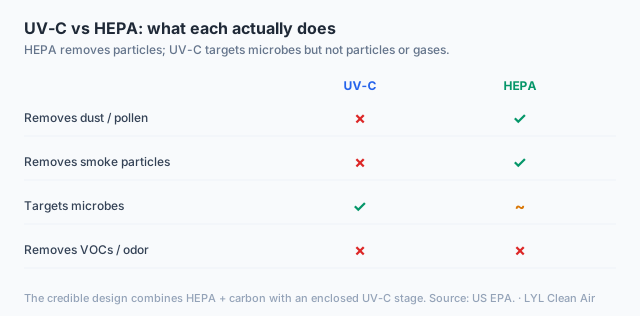
UV-C vs HEPA, Side by Side
| HEPA | UV-C | |
|---|---|---|
| Mechanism | Physically traps particles in filter media | UV light damages microbe DNA/RNA |
| Removes particles? | Yes — ≥99.97% at 0.3µm | No — dust/pollen pass through |
| Targets microbes? | Traps them with particles | Yes — its main purpose |
| VOCs / gases | No (needs carbon) | No |
| Key limitation | Doesn't kill trapped microbes | Needs dwell time; poor designs may emit ozone |
Sources: US EPA — air cleaners in the home; Medical News Today — UV air purifiers.
Why UV-C Alone Is Not Enough
The core limitation: a UV-C-only device may neutralize some microbes, but it does not physically remove particulate matter such as dust, pet dander or pollen, and it is not effective against VOCs, gases or chemical fumes. Two more real-world constraints: air moves quickly through a purifier, which limits the UV contact (dwell) time needed to be effective, and cheap UV/ionizer designs can produce ozone as a byproduct — a compliance and safety issue (see CARB's 0.050 ppm limit). So a "UV air purifier" marketed as a complete solution overpromises.
The Credible Design: HEPA + UV-C Hybrid
The strongest configuration combines the two so each covers the other's gap: HEPA + activated carbon removes particles and odors, and a properly enclosed UV-C chamber with adequate dwell time adds microbial reduction. Three engineering rules make it honest:
- Sealed UV chamber with enough dwell time — not a token bulb in the airflow.
- Ozone-free / low-ozone UV design that meets CARB and EU limits.
- Claims matched to certification — any germicidal or disinfection claim needs the appropriate approval and test evidence for the market.
LYL Clean Air's roots are in UV application and air disinfection, so we build UV-C as an engineered, enclosed stage on top of mechanical HEPA + carbon — and we keep the marketing claims within what the certification supports.
Planning a HEPA + UV-C line?
Tell us your target market and claim positioning — we will recommend a compliant HEPA + carbon + UV-C configuration.
Request Model OptionsRelated Guides
- Ionizer vs HEPA — the other "active" technology and its ozone risk.
- Hospital air purifier — where microbial reduction matters most.
- CARB & ozone limits — why UV design affects US compliance.
- Air purifier models — browse the OEM/ODM range.
General sourcing information, not medical advice. Germicidal and disinfection claims require certification and test evidence for the target market.