
By the LYL Clean Air Engineering Team · Published Jul 16, 2026 · Updated Aug 6, 2026
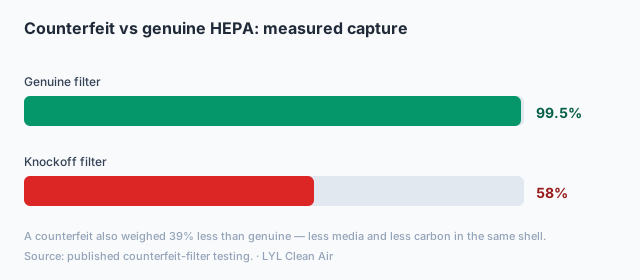
This topic matters to us from both sides: we manufacture legitimate compatible and private-label replacement filters, and nothing damages the category — or an appliance brand's reviews — like counterfeits that turn a working purifier into a fan. Here is the documented evidence and the checklist, applicable whether you are a consumer, a marketplace seller, or a brand planning a filter program.
What the documented cases show
| Case | Finding |
|---|---|
| Capture rate | A knockoff removed ~58% of particle pollutants where the genuine filter removed ~99.5% (IQAir documentation) — the owner believes they are protected while nearly half the fine particles pass through |
| Material shortfall | A counterfeit weighed 17.75 lbs vs 24.5 lbs genuine — 39% less — consistent with less filter media and less carbon inside the same-looking shell |
| Unregulated media | Fiber material in fakes is neither regulated nor consistently sourced — thinner media also saturates and fails sooner |
| Label loophole | "HEPA-type", "HEPA-like", "HEPA-ready" and bare "99% efficiency" claims have no standardized test behind them — legal wording, unverifiable performance |
Sources: IQAir — why you shouldn't buy fake filters; Vacuum Wars — not all HEPA filters are equal; HEPA-type label loophole explained.
The 5-point authenticity check
- 1. Weigh it. Media and carbon are most of a filter's mass. If the genuine spec or your previous filter weighs noticeably more, the new one is lighter for a reason.
- 2. Inspect the seal. A real filter seals with a continuous, compressible gasket. Gaps, hard brittle foam, or reliance on a loose friction fit let air go around the media — a bypassing filter performs worse than its media grade regardless of what the media could do.
- 3. Measure the dimensions. To the millimetre, and check the airflow arrow. A few millimetres short creates a permanent bypass channel; a few millimetres long means the door forces the frame out of true.
- 4. Read the class, not the vibe. Demand a real filter class — EN 1822 H11/H13/H14 or US True HEPA (99.97% @ 0.3 µm). "HEPA-type" is marketing, not a measurement.
- 5. Ask for the test report. A legitimate manufacturer supplies an accredited report whose model number matches the SKU. Sellers who decline, or whose report names a different model, have answered your question. (Same rule as our HEPA quality verification guide.)
Compatible ≠ counterfeit: the honest distinction
Owner forums often lump "aftermarket" and "fake" together, and the confusion is understandable — but the line is bright:
| Legitimate compatible filter | Counterfeit / knockoff |
|---|---|
| Sold openly as compatible, under its own maker's name | Imitates the brand's packaging, or hides who made it |
| Stated filter class with accredited test report | "HEPA-type" wording or reports that don't match the model |
| Published media area, carbon weight, gasket spec, dimensions | No specs to check — and a weight that wouldn't survive checking |
| Priced on materials — cheaper than the brand box, not impossibly cheap | Priced to make you skip the questions above |
That left-hand column is our manufacturing standard for private-label and compatible replacement filters: EN 1822 class with report, stated media and carbon weights, CCM grade matched to the claimed replacement interval, and dimensional drawings buyers can verify.
For brands: how to defend your buyers (and your reviews)
- Publish the checkable numbers on the filter SKU page — class, report number, media/carbon weights, dimensions. Fakes thrive on unverifiable listings.
- Tamper-evident packaging + batch codes — cheap to add at the factory, decisive in marketplace disputes.
- Keep genuine filters in stock and fairly priced. Counterfeits win when the real filter is $60 and backordered; a planned replacement program is the structural defense.
Planning a filter line buyers can verify?
H11/H13/H14 replacement filters with accredited reports, stated media and carbon weights, CCM grading and private-label packaging — the anti-counterfeit spec by design.
Replacement Filter ProgramFrequently asked questions
How do I spot a fake HEPA filter?
Weight vs spec, continuous gasket, millimetre-true dimensions, a real filter class (not "HEPA-type"), and a test report matching the model number. Too-cheap is a signal, not a bargain.
How much worse are fakes?
Documented testing: ~58% capture vs ~99.5% genuine, and a counterfeit weighing 39% less than the real filter. The look survives; the performance doesn't.
Are compatible filters safe to buy?
Legitimate compatible filters — openly labeled, class-certified, spec-published — are a normal, honest category. The danger is unverifiable listings, whoever made them.
Related guides
- Replacement filter supply — our verifiable-by-design filter manufacturing.
- Verifying HEPA quality — the documents to request before ordering.
- Can you wash a HEPA filter? — the other way filters lose their performance.
- H13 vs H14 — what the real filter classes mean.
Case figures cited from the named public sources. General sourcing guidance; verify any filter against its own test documentation.