
By the LYL Clean Air Engineering Team · Published Jul 16, 2026 · Updated Aug 6, 2026
Purifier-humidifier combos are one of the fastest-growing formats we build — and white dust is the #1 avoidable complaint in the category. Here is what it is, what actually fixes it, and the engineering choices that separate a well-designed 2-in-1 from a returns magnet.
Where the white dust comes from
An ultrasonic humidifier vibrates a small plate at high frequency, shattering water into a cool, fine mist — without boiling it. That efficiency is also the catch: everything dissolved in the water goes airborne with it. Hard tap water carries calcium, magnesium and other minerals; when the droplets evaporate mid-air, those minerals remain as microscopic particles that settle as a fine white film on furniture and electronics. Researchers have documented that ultrasonic and impeller humidifiers are particularly efficient at dispersing tap-water minerals into room air.
The sensor plot twist: the combo can "see" its own mist
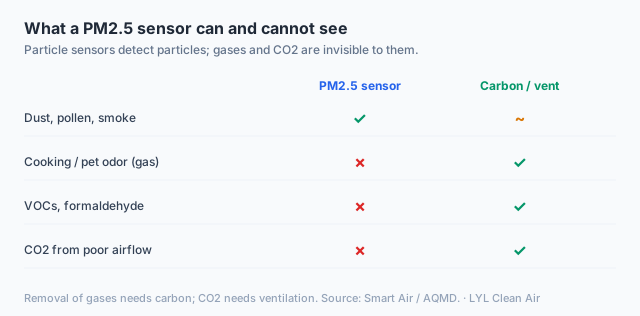
Laser PM2.5 sensors count scattered light from particles — and both mist droplets and the mineral particles left behind register as PM2.5. A peer-reviewed indoor-air study measured substantially elevated PM2.5 concentrations from ultrasonic humidifiers running on tap water, driven by aerosolized minerals; with low-mineral water the effect largely disappears. Practical consequences:
- An air-quality monitor near the unit will spike when the mist runs on tap water — the reading is real particles, not a sensor glitch (see our sensor accuracy guide).
- A poorly designed combo in auto mode can chase its own humidifier — fan ramping up against the mist plume. Sensor placement and firmware smoothing are design decisions, not luck.
What actually fixes it
| Measure | Effect |
|---|---|
| Distilled water | Most effective — distillation removes minerals best; white dust essentially stops |
| Demineralization cartridge | Strips minerals from tap water in the tank; good everyday compromise in hard-water areas |
| RO / deionized water | Removes most minerals; slightly less complete than distillation |
| Tank cleaning ~every 3 days | EPA use-and-care guidance — controls scale and microbial growth in any humidifier |
Sources: US EPA — use and care of home humidifiers; Indoor PM2.5 by water type and humidification method (peer-reviewed, PMC); Kaiterra — humidifiers and IAQ readings.
How an honest 2-in-1 is engineered (OEM checklist)
- Design the tank for cleaning — wide fill opening, reachable corners, dishwasher-safe parts where possible. A tank users can't clean every few days is a hygiene complaint on a timer.
- Offer a demineralization cartridge option — and list it as a consumable SKU alongside the HEPA filter, the same way we plan replacement filter programs.
- Put the water guidance in the manual and on the box — "use distilled or demineralized water in hard-water areas" printed up front prevents the one-star review later.
- Place the PM sensor out of the mist plume and smooth auto-mode response so the purifier doesn't duel its own humidifier.
- Keep the claims honest: the HEPA stage cleans particles; the ultrasonic stage adds humidity and — on tap water — some mineral aerosol. Positioning a combo as "purifies while it humidifies, use distilled water for best results" is accurate and defensible.
Planning a 2-in-1 or 3-in-1 combo line?
We build purifier + ultrasonic humidifier combos with cleanable tanks, demineralization options, sensible sensor placement and honest documentation — tell us your target market.
Humidifier Combo OEM OptionsFrequently asked questions
Is humidifier white dust harmful?
It is settled tap-water minerals. The prudent position — and the one supported by indoor-air researchers — is to minimize breathing any fine particulate: use distilled/demineralized water so the dust is not generated in the first place.
Why does the purifier speed up when the humidifier runs?
On tap water, the mist carries minerals that laser PM sensors legitimately count as PM2.5, so auto mode reacts. Mineral-free water removes most of the effect; good combos also place the sensor away from the mist path.
Does the HEPA filter catch the white dust?
Airborne mineral particles that pass through the purifier are captured like any PM2.5 — but most of the mist settles on surfaces before recirculating. Fixing the water beats filtering the aftermath.
Related guides
- Purifier + humidifier combo OEM — the 2-in-1 / 3-in-1 category page.
- PM2.5 sensors & auto mode — why the display reacts to mist.
- 3-in-1 purifier-humidifier-diffuser — our combo model.
- Filter care guide — which parts of a combo are washable.
General product guidance based on cited sources; follow the specific model's manual. Water hardness varies by region — recommendations assume typical municipal tap water.