
By the LYL Clean Air Engineering Team · Published Jul 9, 2026 · Updated Aug 20, 2026
The Corsi-Rosenthal box went viral for the best possible reason: it is cheap, transparent about its physics, and backed by real measurements published by real researchers. In air-quality communities like Reddit it is the default answer to "I have $80 and bad air." This page takes the phenomenon seriously — because the physics that make it work are the same physics behind every good commercial purifier we build.
What the studies actually measured
| Evidence | Finding |
|---|---|
| EPA wildfire-smoke chamber test | A four-filter Corsi-Rosenthal box using 1-inch MERV 13 filters and a shroud measured 401 ± 31 CFM wildfire-smoke CADR. |
| 2025 peer-reviewed longevity study | Four boxes were followed for 40 weeks. After 4.8 g of deposited particles, boxes using the same filter brand retained about 62–70% of initial CADR, depending on particle size. |
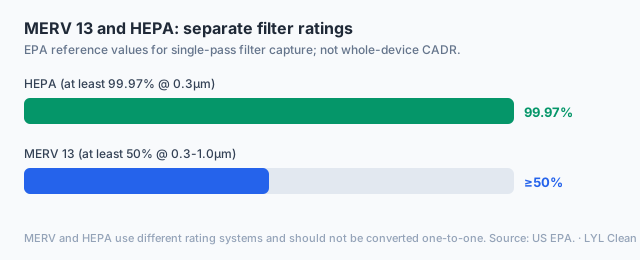
| EPA filter-rating reference | MERV 13 is rated at ≥50% for 0.3–1.0 µm, ≥85% for 1.0–3.0 µm and ≥90% for 3.0–10 µm. HEPA is a separate rating. |
Primary sources: US EPA DIY air-cleaner test; Environmental Science: Processes & Impacts longevity study; US EPA MERV reference; UC Davis build guide.
Why a taped box performs this well
One word: filter area. Four or five full-size furnace filters give the box several times the media surface of a compact consumer purifier. Air moves through each square centimetre slowly — low face velocity — which keeps capture efficiency high and resistance low, so an ordinary box fan can push serious airflow. That is not a hack; it is exactly the principle premium purifiers pay for with large pleated filters and big intake grilles. The DIY community simply bought it at a hardware store.
Where each side wins
| Corsi-Rosenthal box | Commercial purifier | |
|---|---|---|
| Cost per CFM | Often strong — depends on fan, filter and replacement cost | Pays for engineering beyond airflow |
| Noise and controls | Depends on the chosen fan; usually no sleep mode | Advantage — request per-speed noise, controls and standby data |
| Filtration grade | MERV 13: ≥50% at 0.3–1 µm in its rating method | HEPA filter claims require the applicable filter evidence and sealed-device design |
| Safety & market evidence | DIY components; follow EPA fan-age and obstruction guidance | Advantage — model-specific electrical, EMC, ozone and labeling documents |
| Footprint & looks | A 50 cm cardboard-and-tape cube | Wins in living spaces, hotels, clinics |
| Long-term ownership | Re-build with new filters; no warranty | Wins — replacement filter supply, warranty, support |
Honest bottom line: for a garage, a classroom on a budget, or wildfire-smoke emergencies, the box is superb and we would never talk a homeowner out of one. For a bedroom you sleep next to, a hotel fleet, a clinic, or anything you intend to sell under a brand, the commercial unit's noise engineering, certifications and guarantees are the product.
Three lessons the CR box teaches product planners
- Buyers are airflow-literate now. The DIY community normalized comparing CADR per dollar. Spec sheets with one vague "coverage" number no longer survive scrutiny — publish real CADR and per-speed noise, as we do via SKU test reports.
- Filter area is the honest path to quiet performance. The box wins with media surface; a well-designed commercial unit should too. Skimping filter area and compensating with fan speed produces the loud, returned product — see our noise-levels guide.
- Transparent numbers build the trust marketing can't. The box became a phenomenon because researchers published measurements anyone could check. That is the standard buyer content should meet.
Want CR-box physics in a sellable product?
For a branded launch, review the private-label air purifier sourcing checklist, then send the destination market, target CADR, acceptable noise and order quantity. We will identify models and the exact test-document set available for review.
Request Model EvidenceRelated guides
- MERV vs HEPA — the rating systems behind the comparison.
- How quiet should a purifier be? — the box's biggest weakness, engineered.
- CADR calculator — how much airflow your room actually needs.
- CARB certification — why sellable units need listing.
Study figures cited from the named public sources; DIY performance varies with fan, filters and build quality. General sourcing information.