By the LYL Clean Air Engineering Team · Published Jul 9, 2026 · Updated Aug 6, 2026
Scroll any air-purifier discussion thread and the same complaint keeps surfacing: the unit cleaned the air fine, but the buyer returned it because they couldn't sleep next to it. For a brand, noise is not a spec-sheet footnote — it is one of the top drivers of returns and one-star reviews on bedroom-positioned products. This guide explains the numbers, the design factors behind them, and how to source quiet units honestly.
What the dB numbers actually mean
| Sound level | Comparable to | Sleep impact |
|---|---|---|
| ~20 dB | Rustling leaves | Inaudible to most sleepers |
| ~30 dB | A whisper | WHO bedroom night limit for good sleep |
| 30–40 dB | Quiet library | Can cause stirring and awakenings in sensitive sleepers |
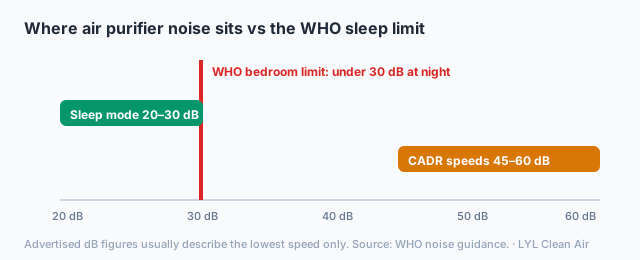
| 45–60 dB | Conversation / office | Typical purifier at medium-high speed; too loud for sleep |
Sources: WHO — noise and health (bedroom guideline <30 dB at night, peaks <45 dB); HouseFresh — quiet air purifier testing.
The sleep-mode trick every buyer should know
Marketing pages love a "20 dB!" headline. Independent testers point out the catch: that figure almost always describes the lowest fan speed only. Run the same unit at the speed that actually delivers its advertised CADR and you are often looking at 45–60 dB. Neither number is a lie — but quoting only one of them is not the whole truth either.
The practical consequence: a bedroom unit should be chosen so that its quiet setting cleans the room adequately. That means sizing up — a purifier with generous maximum CADR can idle along at 22 dB overnight and still deliver meaningful air changes, while a unit picked exactly to spec has to scream at full speed to keep up. Our CADR calculator helps you find the target number; add headroom for night operation.
What makes a purifier genuinely quiet: 4 design factors
- Brushless DC motor. Quieter, more efficient and longer-lived than AC motors; also enables fine-grained speed control for a true night setting.
- Airflow path and blade design. Turbulence is noise. Smooth intake geometry, balanced impellers and adequate outlet area matter more than any "silent" sticker.
- Filter area. The more filter surface, the slower the fan can spin for the same clean-air output. Compact units with small filters are loud by physics, not by accident.
- A real sleep mode. Lowest speed plus display lights off — light-sensitive sleepers complain about LED glow as often as noise. A sleep mode that leaves a bright PM2.5 display on misses the point.
What this means for OEM buyers
If you are building a bedroom-positioned SKU, put these in the spec sheet conversation with your factory:
- Ask for dB at every fan speed, measured at a stated distance (1 m is common) — not a single lowest-speed figure. We provide per-speed noise data from the SKU test report rather than one marketing number.
- Match motor and filter area to the noise target: if the brief says "under 25 dB at night in a 15 m² bedroom," the engineering answer is a DC motor and enough filter area — which affects body size and cost. That trade-off belongs in the quotation, not in the returns queue.
- Specify the sleep-mode behavior: lowest speed, display off (or dimmed), and no beeps on auto-mode changes.
- Position honestly on the box: "22 dB (sleep mode)" with the speed disclosed beats a bare "22 dB" that generates one-star reviews.
Building a quiet bedroom line?
Tell us your room size and noise target — we will recommend the motor, filter configuration and sleep-mode behavior, with per-speed dB data from the test report.
Request Model OptionsFrequently asked questions
How many decibels is a quiet air purifier?
About 19–35 dB on the lowest speed for well-designed units. For overnight use, stay at or below the WHO's 30 dB bedroom guideline — ideally low-to-mid 20s.
Why does my purifier seem louder than the advertised dB?
The advertised figure is almost always the lowest fan speed. At the speeds delivering the advertised CADR, expect 45–60 dB. Compare units by per-speed noise data.
Does quiet mean less cleaning power?
At the same moment, yes — lower speed is lower CADR. Size the unit so its quiet setting covers the room; use max speed for quick clean-ups only.
Related guides
- CADR calculator — size the unit so its quiet setting is enough.
- Bedroom air purifier — our bedroom-positioned model.
- Baby-room configuration — where quiet matters most.
- CADR and room size — the sizing method behind the headroom rule.
General sourcing information. Noise levels vary by model and measurement method; confirm per-speed dB data against the SKU test report.