
By the LYL Clean Air Engineering Team · Published Jul 12, 2026 · Updated Aug 9, 2026
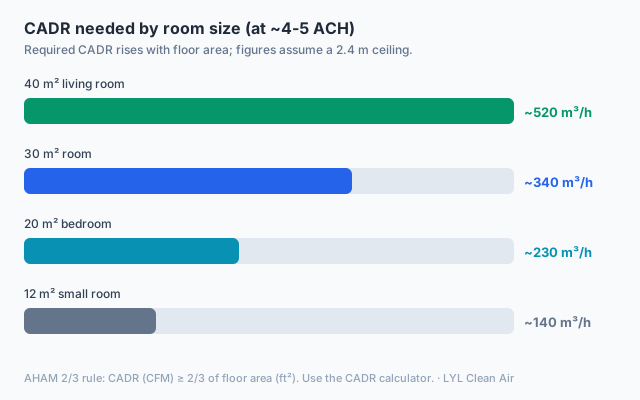
Wildfire smoke is the one scenario where much of the everyday air-purifier advice inverts: quiet modes, auto modes and ordinary sizing all give way to continuous clean-air output. The baseline below comes from current US EPA wildfire guidance; the higher target comes from AHAM's wildfire-specific recommendation.
EPA 2/3 CADR rule: worked room-size examples
Baseline formula: minimum tobacco-smoke CADR (CFM) = room area (ft²) × 2/3, assuming an 8 ft ceiling. AHAM recommends matching smoke CADR to the room's square footage for stronger wildfire performance.
| Room area | EPA 2/3 baseline | AHAM wildfire target |
|---|---|---|
| 120 ft² | 80 CFM | 120 CFM |
| 300 ft² | 200 CFM | 300 CFM |
| 600 ft² | 400 CFM | 600 CFM or multiple units |
Ceiling rule: both figures assume an 8 ft ceiling. For a higher ceiling, use a larger cleaner or calculate by room volume and target air changes with the CADR calculator.
The EPA clean-room playbook, step by step
| Step | What to do | Why |
|---|---|---|
| 1. Pick one room | A bedroom or living room the household can stay in; doors and windows closed | Concentrate clean-air capacity where people actually are |
| 2. Stop making particles | No cooking, candles, smoking or vacuuming in the clean room | Indoor sources can rival the smoke you're keeping out |
| 3. Run HEPA on high, continuously | Highest fan speed for the duration of the event | EPA smoke guidance — infiltration outpaces low settings |
| 4. Size by smoke CADR | EPA baseline: tobacco-smoke CADR (CFM) ≥ 2/3 of room area (ft²) | Use AHAM's room-area target for heavier wildfire smoke |
| 5. Watch the outdoor AQI | Track AirNow.gov; air out the house when outdoor air clears | Smoke events pulse — ventilate in the clean windows |
Sources: US EPA — preparing for smoke and heat; US EPA — create a clean room; AHAM Verifide — air filtration standards.
The part HEPA cannot do: the smell
Smoke is particles plus gases. HEPA media captures the PM2.5 that damages lungs, but the campfire smell rides on gases and VOCs that sail through any particle filter. Two consequences:
- Odor control needs real activated carbon — substantial mass, not a spray-coated pad. The same rule as VOC removal: performance is proportional to carbon quantity and contact area.
- Carbon saturates fast in heavy smoke. A filter that lasts a year in normal use can exhaust its carbon in weeks of continuous smoke duty. Households should stock a spare filter set before the season — and retailers should plan inventory the same way.
Why the "run it on high" advice inverts normal guidance
Our noise guide tells bedroom buyers to size up so the quiet setting suffices. Smoke events flip that: the priority is maximum clean-air output, and EPA guidance says to run the cleaner continuously on its highest fan setting. If noise is a concern, choose a larger unit whose lower setting still meets the required tested smoke CADR. Use the CADR calculator at 5–6 air changes per hour for a smoke-ready target.
What this means for brands and distributors
- Smoke season is a demand pulse, not a trend — North American and Australian fire seasons reliably spike search and retail demand. Inventory and content should be in place a quarter ahead.
- Spec the smoke CADR, not just "coverage." Buyers following EPA/AirNow guidance look for the smoke figure specifically; we quote it from the SKU's AHAM AC-1 or GB/T 18801 test report.
- Bundle replacement filters. A machine + spare-filter bundle matches how smoke actually consumes carbon, raises order value, and prevents the "filter sold out mid-event" review.
- High-CADR towers and commercial units are the right platforms for this positioning — see tower OEM and commercial OEM.
Stocking for smoke season?
Tell us your market and room-size targets — we will match high-CADR HEPA + carbon models, quote smoke CADR from test reports, and plan machine + filter bundles.
Request Model OptionsFrequently asked questions
Do air purifiers work for wildfire smoke?
Yes — EPA advises using a properly sized HEPA portable air cleaner to reduce indoor smoke particles. Size by tobacco-smoke CADR, run it continuously on high and keep the clean room closed.
What CADR is needed for a 120 ft² room?
The EPA 2/3 baseline is at least 80 CFM for an 8 ft ceiling. AHAM's stronger wildfire target is about 120 CFM. Size up for higher ceilings or heavy smoke.
Does HEPA remove the smoke smell?
No. The smell is gases/VOCs that pass through HEPA; you need a substantial activated-carbon stage, and it saturates faster during smoke events.
High or quiet mode during a smoke event?
High, per EPA guidance — or size up so medium speed already meets the target. Everyday quiet-mode advice applies to everyday air.
Related guides
- CADR calculator — set it to 5–6 ACH for smoke-ready sizing.
- Smoking-room configuration — the heavy-carbon architecture smoke demands.
- Corsi-Rosenthal box vs commercial — the DIY option many households use in emergencies.
- Granular carbon vs carbon cloth — why carbon mass decides odor performance.
General guidance based on cited public-health sources; not medical advice. For health decisions during smoke events follow local authorities. Confirm smoke CADR against the SKU test report.