By the LYL Clean Air Engineering Team · Published Jul 12, 2026 · Updated Aug 6, 2026
Electricity cost is the quiet objection behind many abandoned carts and "does it really need to run all day?" support tickets. Retailers get this question constantly; the honest math below is the answer — and the design choices that keep the number small are worth putting on the spec sheet.
The math, once and clearly
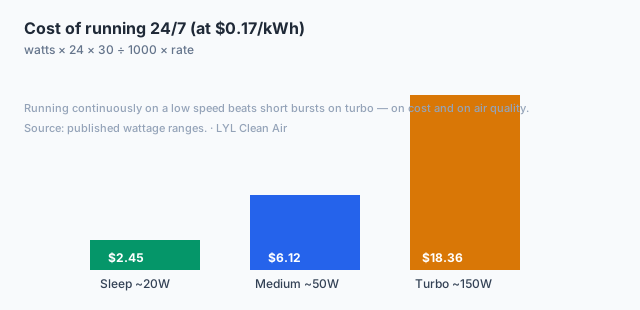
Monthly cost = watts × 24 h × 30 days ÷ 1000 × rate ($/kWh)
Example: 50 W × 24 × 30 ÷ 1000 = 36 kWh; at $0.17/kWh → ≈ $6.12/month.
| Running speed (typical draw) | kWh / month (24/7) | @ $0.10/kWh | @ $0.17/kWh | @ $0.30/kWh |
|---|---|---|---|---|
| Sleep ~20 W | 14.4 | $1.44 | $2.45 | $4.32 |
| Medium ~50 W | 36 | $3.60 | $6.12 | $10.80 |
| Turbo ~150 W (large units) | 108 | $10.80 | $18.36 | $32.40 |
Wattage ranges and cost estimates per published guides: Airdog — 24/7 running costs; Alen — purifier electricity use. Your unit's actual per-speed wattage belongs on its spec sheet — ours comes from the SKU test report.
Why 24/7 on low beats bursts on turbo
Particle levels rebound quickly once filtration stops — running continuously at a modest speed holds a clean baseline, while occasional turbo bursts chase spikes at the highest wattage. Two design facts make continuous-low the cheap option:
- Fan power scales steeply with speed — sleep-to-turbo spans roughly 15–25 W to 100–200 W on typical units, so the quiet speeds are dramatically cheaper, not slightly.
- A generously sized unit cleans adequately on low. The same sizing headroom that makes a bedroom unit quiet also makes it cheap: size with the CADR calculator, then live on the low setting.
The engineering that shrinks the bill
- Brushless DC motors — higher efficiency than AC motors at every speed and finer speed control for genuinely low sleep-mode draw; standard across our lineup.
- ENERGY STAR certification (US market) — the EPA program certifies room air cleaners meaningfully more efficient than standard models (published figures: roughly 25–40% better). For 24/7 appliances the label converts directly to bill savings and is a recognized US retail differentiator — available on qualifying models per project.
- Honest per-speed wattage on the spec sheet — the same transparency rule as per-speed dB: one "rated power" number hides the range buyers actually pay for. We quote per-speed W from the SKU test report.
- Schedules and app control — a smart Wi-Fi model that drops to sleep speed overnight automates the cheap pattern.
Building a line where "cheap to run" is a selling point?
DC-motor platforms with low sleep-mode draw, per-speed wattage from test reports, and ENERGY STAR options per project — tell us your target market.
Request Model OptionsFrequently asked questions
How much does running an air purifier 24/7 cost?
Watts × 24 ÷ 1000 × your rate. A 50 W unit at $0.17/kWh ≈ $6/month; published typical ranges run from under $1 to ~$10/month.
Is it OK to leave it on all day?
Yes — continuous operation is the intended use, and a low continuous speed beats turbo bursts on both air quality and cost.
Do ENERGY STAR purifiers matter?
For 24/7 appliances, yes — the certified efficiency advantage (~25–40% in published figures) shows up directly on the bill, and US retail recognizes the label.
Related guides
- CADR calculator — size up once, run cheap forever.
- Noise levels guide — the same low-speed logic, in decibels.
- Smart Wi-Fi OEM — schedules that automate the economical pattern.
- Filter lifespan guide — the other half of ownership cost.
Costs are worked examples at stated rates; actual bills depend on the unit's measured wattage and local tariffs. Confirm per-speed power against the SKU test report.